
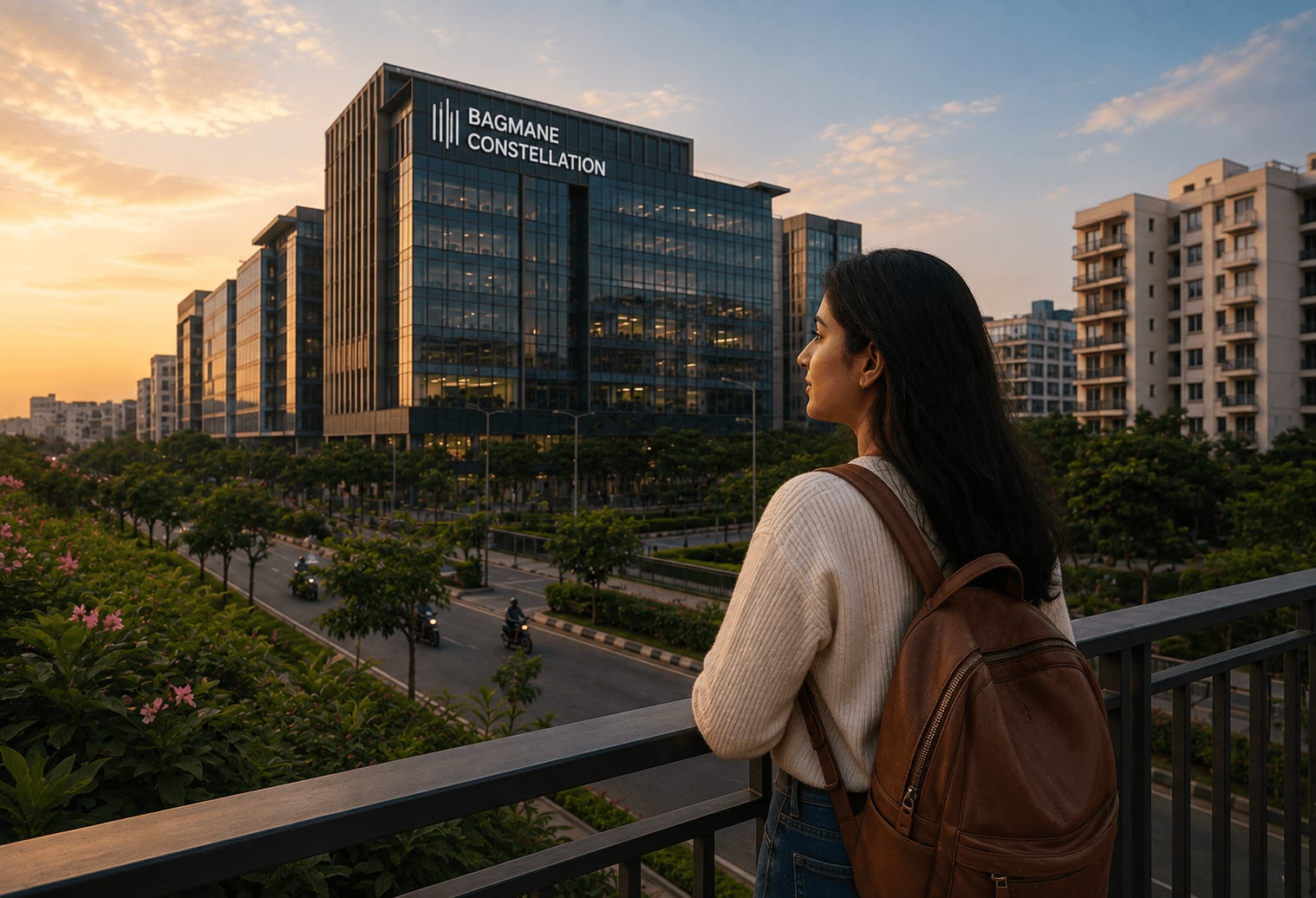
Bagmane Constellation sits on the ORR just south of the Marathahalli junction, making it different from Manyata (north) or Whitefield (northeast). It is one of the largest and most established corporate parks in Bangalore, home to Amazon, Google, IBM, and hundreds of other tech and consulting teams. The location matters because it puts Bagmane at the intersection of three major commute routes: Old Airport Road to the west, the ORR to the south, and the emerging metro corridor to the east. If you want the shortest commute, live east of the park; if you want lower rent, accept a longer commute. Choosing where you live determines whether your commute is twenty minutes or forty-five.
The Bagmane commute picture
Bagmane is not a single building but a 42-acre campus with multiple towers scattered across the park. Which tower you work from affects which areas feel close. Google and Amazon dominate different sections, and many smaller companies occupy spaces throughout. This matters because an auto ride from Marathahalli to the south end of the park differs from one to the north end of the park.
Three commute corridors actually matter for Bagmane. First is Old Airport Road and Old Madras Road, which run east-west directly through the area. A two-wheeler on this corridor is fast off-peak and tolerable at peak because it is not the main IT traffic artery. Second is the Purple Line metro, with KR Puram station about three kilometers east and Baiyappanahalli station about four kilometers west. Combining metro plus auto is the most predictable commute and insulates you from ORR traffic. Third is the Outer Ring Road itself, which gets you to south Bangalore faster but takes longer during peak hours because it concentrates all traffic onto a single corridor.
The practical implication: Bagmane is better served by areas east of the park than by the ORR south belt. CV Raman Nagar is closest; KR Puram and Banaswadi use the metro effectively; Marathahalli is directly south on the ORR. If you want the best balance of commute and cost, start with CV Raman Nagar or KR Puram. Choosing anything further requires accepting either a longer commute or a specific trade-off, such as having a partner who works elsewhere.
Areas that work for a Bagmane commute
CV Raman Nagar: closest option, premium pricing
CV Raman Nagar sits immediately east and slightly north of Bagmane, with some pockets almost adjacent to the park. The commute is typically 10 to 20 minutes by two-wheeler or auto, making it the fastest option available.
Room costs here are premium. A shared 2BHK runs roughly Rs 35,000 to Rs 50,000 per month, putting per-head costs at Rs 17,500 to Rs 25,000 for two people sharing. A 3BHK runs from Rs 45,000 to Rs 60,000, making per-head costs Rs 15,000 to Rs 20,000 for three people. Deposits are six to ten months, same as everywhere else, but the base rent is higher, so the absolute deposit amount is larger.
CV Raman Nagar has good social infrastructure, restaurants, and shops. It has become an established tech hub, which both drives demand and keeps competition moderate. The area is landlord-friendly, meaning terms are negotiated rather than dictated, and bachelors are readily accepted.
Choose this area if the shortest commute justifies the higher rent, or if your partner works elsewhere and CV Raman Nagar is a reasonable midpoint. If not, the metro-corridor options may fit better.
KR Puram and Banaswadi: metro corridor, moderate cost
KR Puram sits east of Bagmane, about three kilometers away, directly on the Purple Line metro. Banaswadi sits farther east, about five kilometers away, and is also on the metro. Both are two-wheeler or auto rides from their respective metro stations to Bagmane, making this the corridor where metro is actually useful for your commute.
Commuting by metro plus auto is typically 30 to 40 minutes off-peak and predictable because you are not fighting ORR traffic. Commuting by two-wheeler is faster, roughly 20 to 30 minutes, depending on the time of day.
Room costs are moderate. A shared 2BHK in KR Puram runs roughly Rs 30,000 to Rs 45,000 per month, making per-head costs Rs 15,000 to Rs 22,500. In Banaswadi, the same flat might run Rs 25,000 to Rs 40,000, making per-head costs Rs 12,500 to Rs 20,000.
Both areas have established flat-share communities and moderate listing supply. Landlords are bachelor-tolerant. KR Puram has better social infrastructure and more cafes. Banaswadi is slightly cheaper and more residential. If the metro corridor fits your routine, these are the next practical choices.
Marathahalli: south side, direct but congested
Marathahalli sits on the ORR directly south of Bagmane, about two kilometers away by straight-line distance. Commuting by car or two-wheeler to Bagmane is typically 10 to 20 minutes off-peak, but peak-hour commute times on the ORR can stretch to 40 minutes or longer because you are fighting concentrated southbound traffic.
Room costs are similar to KR Puram. A shared 2BHK runs roughly Rs 28,000 to Rs 40,000 per month, making per-head costs Rs 14,000 to Rs 20,000. A 3BHK runs from Rs 35,000 to Rs 50,000, making per-head costs Rs 11,500 to Rs 16,500.
Marathahalli has by far the deepest flat-share supply of any area serving Bagmane, as it is the established IT hub and hosts multiple ORR parks. Supply depth means you have many options but also means competition is higher and negotiating power is lower. Deposits are standard six to ten months.
Choose Marathahalli if you want the most options and don't mind peak-hour traffic, or if you are on a hybrid schedule with flexible commute timing. If you want to go wider, the next options trade convenience for distance.
Brookefield and Whitefield: northwest options, longer commutes
Brookefield sits northwest of Bagmane, about five kilometers away, and Whitefield sits further northwest, about ten kilometers away. Both require going around the ORR and the Marathahalli junction, adding travel time.
Commute to Bagmane from Brookefield is typically twenty to thirty minutes off-peak, and forty to fifty minutes at peak because you are crossing multiple junctions. From Whitefield, commute time is 30 to 50 minutes off-peak and can exceed an hour at peak.
Room costs in Brookefield are similar to those in CV Raman Nagar, ranging from Rs 16,000 to Rs 20,000 per head. Whitefield is slightly higher, running Rs 16,000 to Rs 22,000 per head.
The only reason to choose these areas for a Bagmane commute is if your partner works in Whitefield, or if the area's social scene or amenities justify the extra commute. Otherwise, they make the commute harder than it needs to be. If that trade-off does not work, Indiranagar is the next niche option. For most Bagmane commuters, these are fallback options, not the first choice.
Indiranagar: southeast alternative, niche option
Indiranagar lies southeast of Bagmane, about five kilometers away, and is accessed primarily via Old Madras Road. It is not on the metro, but it has good road connectivity, and the commute is typically 20 to 30 minutes off-peak.
Room costs in Indiranagar are higher than in Marathahalli, typically Rs 18,000 to Rs 24,000 per head for a shared flat. The social scene is strong, and the neighborhood is well-established. Flat shares exist, but supply is moderate.
Choose Indiranagar if you want a neighborhood with stronger social infrastructure than Marathahalli or CV Raman Nagar, and do not mind a slightly longer commute. If you are comparing total costs, the next section breaks those numbers down more directly. Otherwise, CV Raman Nagar and KR Puram remain the better default choices for most Bagmane commuters.
Room costs per head: what you actually pay
A shared 2BHK near Bagmane ranges from roughly Rs 25,000 to Rs 50,000 per month, depending on the area and furnishings. The low end is Banaswadi or budget pockets of Marathahalli. The high end is CV Raman Nagar or premium Marathahalli.
Divided by two people, that range becomes Rs 12,500 to Rs 25,000 per head. Divided by three, it becomes Rs 8,300- Rs 16,500 per head.
A 3BHK follows a similar pattern, running from roughly Rs 35,000 to Rs 60,000 per month. Divided three ways, that is Rs 11,500 to Rs 20,000 per head.
Deposits are six to ten months of rent. A Rs 40,000 2BHK with a six-month deposit is Rs 240,000 total, or Rs 120,000 per person. At ten months, it is Rs 200,000 per person. This absolute number is what stops most cases. Once the pricing is clear, the next question is how Bagmane-specific work patterns affect your search.
Bagmane-specific work dynamics
If you work for Amazon or Google, a significant share of your teammates probably live within a three-kilometer radius of the park, which makes finding flatmates inside your company straightforward. Consulting firms like Accenture and EY have similar patterns. Smaller companies that occupy rented space do not.
Bagmane hiring happens in waves. If you joined in a wave, you and your cohort probably know each other and are apartment-hunting together. If you are joining alone or between waves, flat-share supply is still available, but you are likely to find strangers rather than colleagues.
Company shuttles exist for some large tenants and operate on specific routes. If your company has a shuttle, the shuttle route becomes more important than the area itself, because shuttle routes often skip common residential areas in favor of parking-friendly zones. That makes the next comparison more about commuting trade-offs than location alone.
Commute trade-offs: closer rent versus lower cost
A shared 2BHK flat in Banaswadi at Rs 30,000 per month is Rs 10,000 cheaper than the same flat in CV Raman Nagar at Rs 40,000 per month. Over a year, that is Rs 120,000 saved on rent alone. The commute from Banaswadi by metro plus auto takes 30 to 40 minutes, while the commute from CV Raman Nagar takes 10 to 20 minutes. The final comparison is simple: save money in Banaswadi, or save time in CV Raman Nagar.
Whether that trade-off makes sense depends on your hourly rate, how much commute drives you crazy, and what else you want from your neighborhood. If you work from home three days a week, the commute difference matters less. If you spend that Rs 120,000 saved on a better flat rather than pocketing it, the calculation shifts. If you value Banaswadi's established character over CV Raman Nagar's premium pricing, your choice will differ.
FlatX lets you filter by commute time and workplace proximity, so you can weigh these trade-offs explicitly rather than discovering them mid-lease. With those trade-offs in mind, the last question is where flat shares actually cluster for Bagmane commuters. For most Bagmane commuters, the practical recommendation is to start with east-of-park areas and compare them against cost.
Where flat shares actually cluster for Bagmane commuters
Marathahalli has the deepest listing supply because it is the largest and most established IT professional hub on the ORR. If you search for a room in a shared flat near Bagmane on any platform, most of the results will be in Marathahalli. That is why it remains the default starting point for many searches. For most people, though, that makes it a convenient search area rather than the best commute choice.
KR Puram has moderate supply, concentrated around the metro station and Old Airport Road. Banaswadi has light to moderate supply. CV Raman Nagar and Indiranagar have a moderate supply, but it typically comes from individual owners rather than organized flat-share platforms.
This distribution matters because supply depth means more choice and more negotiating leverage in Marathahalli, but also more competition from other apartment hunters. Moderate supply in KR Puram and Banaswadi means fewer options but steadier negotiating power. Light supply in CV Raman Nagar means you need to be proactive and search actively.
Bagmane layoff cycles and what they mean for flatmates
Bagmane-based companies have specific hiring and attrition patterns. Consulting firms (Accenture, EY) have structured attrition and regular layoffs tied to project completions. Tech companies (Amazon, Google) have less predictable attrition and occasional bulk reorganizations. Smaller occupants have individual employment volatility.
If you are sharing a flat with someone from a consulting firm, expect higher layoff risk than you would with someone from a pure tech role. If you are sharing with someone early in their career, expect a higher likelihood of job changes (such as moving to another city or company). If you are sharing with someone mid-career, expect more stability.
This matters because it affects whether your flatmate stays stable or leaves suddenly. Agreeing on notice period and exit liability upfront means you are protected if someone gets retrenched or changes jobs mid-lease.
What happens if you get transferred within your company or need to move
Large employers at Bagmane sometimes transfer people to other Bangalore offices (Whitefield, Electronic City) or to other cities. If you are transferred, your options are to accept a longer commute, renegotiate with flatmates, or look for a new flat near the new office.
If you leave Bagmane entirely, you can either stay in the flat and find other work, or move to a cheaper area and reduce your budget.
These scenarios are easier to navigate if you agreed upfront with your flatmates on the notice period, exit liability, and how to bring in a replacement flatmate. FlatX surfaces these exit terms and house rules before move-in, which prevents the most common friction points when someone needs to leave mid-lease.
The deposit reality in premium areas near Bagmane
CV Raman Nagar and the premium pockets of Marathahalli command deposits at the high end of the range, commonly nine to ten months of rent. A Rs 45,000 2BHK with a 10-month deposit is Rs 450,000 total, or Rs 225,000 per person if you are splitting with one flatmate.
This is the number that stops people from choosing the nicer, closer areas. The choice becomes: start in a PG for three to six months and save the deposit, join an existing flat as a replacement flatmate (where the deposit is smaller or goes to the person leaving), or choose a cheaper area and accept a longer commute.
Frequently asked questions
Which area is best for a Bagmane commute: Marathahalli, CV Raman Nagar, or KR Puram?
It depends on your priority. CV Raman Nagar is closest (10 to 20 minutes away) but most expensive (Rs 17,500 to Rs 25,000 per head). KR Puram is moderate on both cost and commute (thirty to forty minutes, Rs 15,000 to Rs 22,500 per head). Marathahalli has the most options and moderate cost, but peak-hour traffic on the ORR can stretch commutes to forty-five minutes.
How much should I budget for rent and deposit near Bagmane?
For a room in a shared flat, budget Rs 12,000 to Rs 20,000 per month for rent, and Rs 80,000 to Rs 200,000 for your share of the deposit, depending on the area and how many flatmates there are. Total to move in: plan for Rs 92,000- Rs 220,000 on day one.
Is the metro useful for Bagmane commutes?
Yes, especially if you live in KR Puram or Banaswadi. Metro plus auto is predictable and insulates you from ORR traffic. As a pure two-wheeler, you are likely faster but less predictable. Most people use two-wheelers off-peak and the metro at peak times.
Can I find a flat share through my company?
Large tenants like Amazon and Google have internal networks. Check employee portals and intranet boards first. External platforms will cast a wider net but require more diligence on vetting flatmates.
Is it worth paying more to live close to Bagmane?
If your workplace has high schedule variability, or if you work in the office five days a week, yes. If you are hybrid or flexible, the extra cost might not be worth it. Calculate your weekly office days and commute cost, then decide.
What if my partner works elsewhere in Bangalore?
This is where CV Raman Nagar or Marathahalli become more interesting because they serve multiple ORR parks and have good access to other corridors. Banaswadi and KR Puram are more optimized for Bagmane specifically.
Best time of year to move near Bagmane?
September through November and January through February. Summer (March to May) has sparse listings. Monsoon (June to August) disrupts commutes. Post-holiday (December and early January) is competitive.
The short version
Bagmane sits at the junction of three commute corridors: Old Airport Road running east-west, the ORR running north-south, and the emerging Purple Line metro running east. Which area you choose determines which corridor you use. CV Raman Nagar is closest but most expensive. KR Puram and Banaswadi use the metro effectively and offer a middle ground. Marathahalli has the deepest flat share supply and good value, but ORR peak-hour traffic is real.
The deposit is the decision-maker. A flat near Bagmane asks for a 6- to 10-month deposit, which translates to Rs 100,000 to Rs 200,000 per person. That gap explains why most newcomers start in a PG.
If you are ready to share a flat near Bagmane, FlatX filters by commute area and workplace and documents house rules and exit terms before anyone moves in, which prevents most disputes when someone needs to leave or circumstances change.