
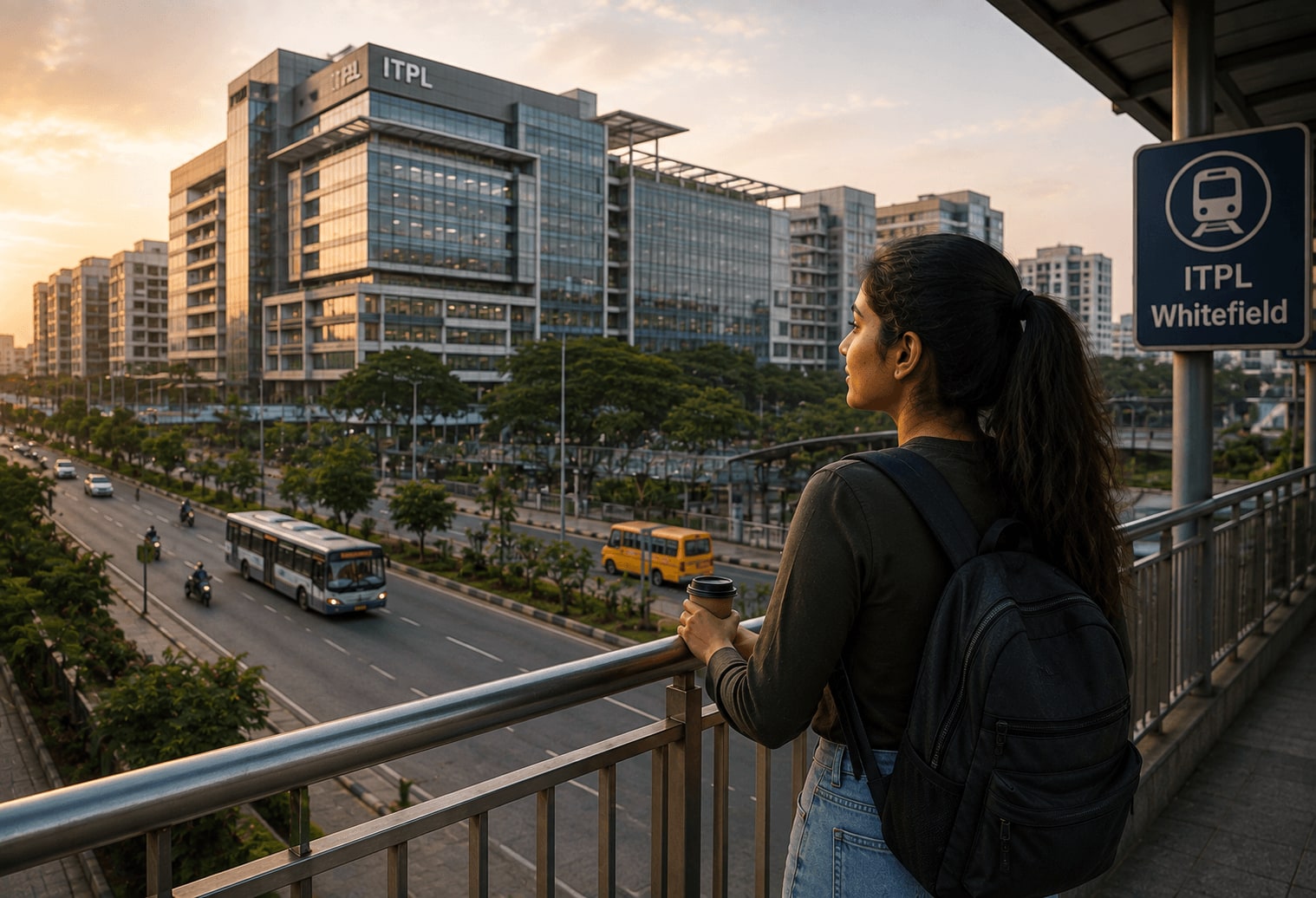
ITPL is located in Whitefield, about 18 kilometers east of Bangalore's city center, on ITPL Main Road, at the heart of East Bangalore's largest tech cluster. It is one of India's oldest and most established technology parks, home to IBM, TCS, Infosys, and hundreds of other tech companies and startups. Whitefield's defining characteristic is that it is relatively young as a tech hub; the park emerged in the 1990s, and the residential infrastructure followed, meaning that, unlike central Bangalore, there is no obvious "default" neighborhood for ITPL workers. Instead, commute patterns are newer and still evolving, shaped by the recent arrival of the Purple Line metro.
The ITPL Whitefield commute picture
ITPL sits roughly in the middle of Whitefield, accessible by road from multiple directions and now directly connected to central Bangalore by the Pattandur Agrahara metro station, which is just 210 meters away from the park entrance. Before the metro arrived, this was a car-dependent commute. Now it is not.
Three commute corridors matter for ITPL workers. The first is the metro: Pattandur Agrahara station on the Purple Line connects you directly to central Bangalore in roughly thirty to forty minutes, depending on where you are going. This corridor is the reason the Whitefield flat share market is expanding so rapidly. The second is Whitefield Road and ITPL Main Road, which form an east-west spine through the area. By two-wheeler, these routes are reasonably fast off-peak and moderately congested at peak. The third is the Outer Ring Road, which provides access to the ORR south belt (Marathahalli, Bellandur) for workers who want a wider, flatter search area.
The practical implication: ITPL is finally becoming metro-accessible, which means you can live in a cheaper area east of Whitefield (Pattandur Agrahara, Kadugodi) and take the metro in, or you can live in Whitefield proper and have a five- to ten-minute commute by two-wheeler or auto.
Areas that work for an ITPL Whitefield commute
Whitefield itself: on-site option, premium pricing
Whitefield has become a premium residential zone driven by decades of IT employment concentration. Room costs here are high, typically Rs 18,000 to Rs 28,000 per head for a shared 2BHK or 3BHK. Premium residential complexes like Prestige Southern Star and others cater explicitly to ITPL workers, but at prices that reflect demand.
The commute is 5 to 15 minutes by two-wheeler or auto, making it the fastest option. The social scene is mature: restaurants, malls (Park Square Mall is within the tech park), and entertainment options are abundant. The flat share market is well-established and competitive.
Choose Whitefield itself only if the cost premium justifies the convenience, or if your company has a shuttle service that starts from Whitefield.
Hoodi and Brookefield: north-west option, middle ground
Hoodi sits directly north of ITPL, about three to five kilometers away. Brookefield sits farther northwest, about 5 to 7 kilometers away. Hoodi Main Road, a secondary commuting route with lighter traffic than Whitefield Road proper, serves both.
The commute from Hoodi to ITPL is typically 15 to 20 minutes by two-wheeler or auto. From Brookefield, it takes 20 to 30 minutes. Both areas are significantly cheaper than Whitefield itself, with room costs typically Rs 14,000 to Rs 20,000 per head.
Hoodi has lighter social infrastructure than Whitefield but is developing rapidly. Brookefield is more established and has a stronger social scene. Both have moderate flat share supply. FlatX lets you filter by commute time and proximity to the area so you can find flatmates in these corridors without the heavy concentration of listings in Whitefield proper.
Pattandur Agrahara and Kadugodi: east side, metro access, budget option
Pattandur Agrahara lies directly east of ITPL, and Kadugodi lies farther east, both on the Purple Line metro. These are the newest residential options for ITPL workers, enabled by the metro extension. Commute by metro plus auto is typically thirty to forty minutes from Pattandur Agrahara, and forty to fifty minutes from Kadugodi. By two-wheeler, commute time is faster but less predictable.
Room costs are the lowest of any area serving ITPL, typically Rs 10,000 to Rs 16,000 per head. This is because these areas are newer and farther from the employment center. Flat-share supply is growing but remains moderate compared to Whitefield proper.
These areas are most useful for people who work a hybrid schedule or are willing to trade commute time for cost savings. A four-day office week with a thirty-minute metro commute is very different from a five-day office week with a forty-minute commute.
KR Puram: south-east option, mixed access
KR Puram sits southeast of ITPL, about five to eight kilometers away, and is also on the Purple Line metro, but at KR Puram station instead of Pattandur Agrahara. The metro commute is typically 40 to 50 minutes. By two-wheeler via the ORR, commute time is faster but requires crossing traffic on a busy road.
Room costs in KR Puram are moderate, typically Rs 13,000 to Rs 20,000 per head. KR Puram has a more established neighborhood character than Pattandur Agrahara or Kadugodi, with better social infrastructure. Flat share supply is more stable.
Choose KR Puram if you want neighborhood character alongside metro access, and do not mind a slightly longer commute.
Marathahalli and Bellandur: ORR south belt, longer commutes
Marathahalli and Bellandur lie south of ITPL on the Outer Ring Road, about 7 to 12 kilometers away. Commute by ORR is typically 20 to 40 minutes off-peak and 45 minutes to an hour at peak. By metro (via KR Puram station), the commute is longer and requires multiple transfers.
Room costs are similar to Hoodi and Brookefield, typically Rs 14,000 to Rs 22,000 per head. These areas have a very deep flat-share supply because they are established IT professional hubs serving multiple ORR parks. Deposits are standard: six to ten months.
The only reason to choose Marathahalli or Bellandur for an ITPL commute is if you want maximum flat share options and don't mind ORR traffic, or if you have a dual commute where the ORR south belt is a midpoint between your office and your partner's.
Read: Flat Sharing in Whitefield Bangalore
Room costs per head: what you actually pay
A shared 2BHK in Whitefield runs from roughly Rs 35,000 to Rs 55,000 per month. Divided by two people, that is Rs 17,500 to Rs 27,500 each. Divided by three, it is Rs 11,500 to Rs 18,300 each.
A shared 2BHK in Hoodi or Brookefield runs from roughly Rs 28,000 to Rs 40,000 per month, making per-head costs Rs 14,000 to Rs 20,000 for two people, or Rs 9,300 to Rs 13,300 for three people.
A shared 2BHK in Pattandur Agrahara or Kadugodi runs from roughly Rs 20,000 to Rs 32,000 per month, making per-head costs Rs 10,000 to Rs 16,000 for two people.
Deposits are six to ten months everywhere. A Rs 30,000 shared 2BHK with a six-month deposit is Rs 180,000 total, or Rs 90,000 per person if splitting with one flatmate.
The metro arrival and what it means for flat sharing
The Purple Line metro extension to Whitefield, completed in late 2024 and operational through 2025, is reshaping the ITPL commute market. Before the metro, living far from Whitefield meant car dependency or unreliable bus commutes. Now it means a reliable thirty- to forty-minute metro ride.
This matters because it unlocks areas like Pattandur Agrahara and Kadugodi, which offer room costs Rs 4,000 to Rs 8,000 cheaper per month than Hoodi, but were previously unviable for ITPL workers without a vehicle. Now, they are increasingly practical, especially for people on hybrid schedules.
The metro also means your commute is no longer at the mercy of ORR traffic. Metro is predictable; ORR is not.
ITPL work patterns and what they mean for flatmates
ITPL is home to some of Bangalore's longest-established tech companies (IBM, Infosys) and some of the fastest-growing startups. IBM and Infosys have structured attrition and annual reorg cycles. Startups have more unpredictable attrition. Software engineers, consultants, and operations staff have different job-change patterns.
This matters for flat sharing because your flatmate's job stability affects whether they stay or leave mid-lease. Agreeing on a notice period and exit liability upfront means you are protected if someone gets retrenched or takes a job elsewhere.
FlatX surfaces house rules and exit terms before move-in, which means you avoid the most common source of flatmate friction: discovering mid-crisis that nobody agrees on what happens when someone leaves.
Commute trade-offs: metro convenience versus onsite proximity
Pattandur Agrahara metro plus auto costs roughly Rs 6,000 less per month than Whitefield itself. Still, it adds 30 minutes to your daily commute (assuming a five-day office week, that is, 50 hours a month spent commuting instead of 40). Over a year, that is Rs 72,000 saved on rent against roughly 600 hours of commute time.
Whether that trade-off makes sense depends on your hourly rate, how much commute stresses you out, and what else you want from your neighborhood. If you work hybrid and in-office two or three days a week, the commute cost is different. If you value Pattandur Agrahara's developing character over Whitefield's premium infrastructure, the choice is different.
FlatX lets you filter by commute area and workplace, so you can make these trade-offs explicit before you commit.
Read: Top 10 Areas to Rent a Flat in Bangalore
Where flat shares actually cluster for ITPL Whitefield
Whitefield itself has the largest supply of flat-share listings because it is the premium residential zone for ITPL workers. If you search for a room on any platform, you will find the most options in Whitefield proper.
Hoodi and Brookefield have moderate supply, growing but still smaller than Whitefield. Pattandur Agrahara and Kadugodi have growing supply driven by metro access, but it is still emerging. KR Puram has established supply within the broader metro corridor.
This distribution means Whitefield offers the most choice but the highest competition. The metro corridor (Pattandur Agrahara, Kadugodi) offers fewer options but more negotiating leverage and lower costs. Middle zones like Hoodi offer a blend.
What happens if you get transferred or need to move
ITPL-based companies sometimes transfer people to other Bangalore offices (Whitefield has multiple parks) or to other cities. Large employers have specific transfer policies. If you are transferred, your options depend on whether the new role is still in Whitefield or elsewhere.
If you stay in Whitefield as a residential base but change jobs, you can commute to a new employer or look for a new flat. If you leave Bangalore entirely, your options are to stay and find local work or move to a cheaper area and reduce your budget.
These scenarios are easier to navigate if you agreed upfront with your flatmates on the notice period, exit liability, and how to bring in a replacement flatmate. FlatX documents these terms before anyone moves in, which prevents the most common friction points.
Frequently asked questions
Which area is best for ITPL Whitefield: Whitefield itself, Hoodi, or metro corridor?
It depends on your priorities. Whitefield is closest (5 to 15 minutes away) but the most expensive (Rs 18,000 to Rs 28,000 per head). Hoodi is the middle ground (15 to 20 minutes, Rs 14,000 to Rs 20,000 per head). The metro corridor is the cheapest (30 to 45 minutes by metro, Rs 10,000 to Rs 16,000 per head). For hybrid work, the metro corridor becomes much more attractive.
How much should I budget for rent and deposit near ITPL?
For a room in a shared flat, budget Rs 10,000 to Rs 20,000 per month depending on area, and Rs 60,000 to Rs 160,000 for your share of the deposit. Total to move in: plan for Rs 70,000- Rs 180,000 on day one.
Is the metro worth using for ITPL commutes?
Yes, especially if you live east of Whitefield. Thirty to forty minutes by metro is predictable and insulates you from ORR traffic. The two-wheeler from Hoodi is faster but less predictable. Most people choose metro if they live on the corridor.
Can I find flatmates through my company?
Large employers like Infosys and IBM have employee networks. Check intranet boards first. External platforms will cast a wider net but require more vetting.
Is it worth paying more to live in Whitefield?
Only if you value the five-to-fifteen-minute commute and premium neighborhood; for most people on a reasonable salary, the Rs 4,000 to Rs 10,000 monthly savings from living in Hoodi or the metro corridor justifies the extra commute time.
Best time of year to move near ITPL?
September through November and January through February. Summer is sparse. Monsoon disrupts commutes. Post-holiday is competitive.
The short version
ITPL is located in Whitefield, which, until recently, was car-dependent but is now metro-connected. Whitefield itself is premium but close. Hoodi and Brookefield are middle ground. The metro corridor (Pattandur Agrahara, Kadugodi) is on budget but adds commute time. For hybrid work, the metro corridor is increasingly practical. For office-every-day, Whitefield or Hoodi make more sense.
The metro arrival is reshaping the market, making distant-but-cheaper areas viable for the first time. The deposit is still the decision-maker: expect six to ten months.
If you are ready to share a flat near ITPL, FlatX filters by commute and workplace proximity and documents house rules and exit terms before anyone moves in, which prevents most of the friction that kills flat shares mid-lease.