
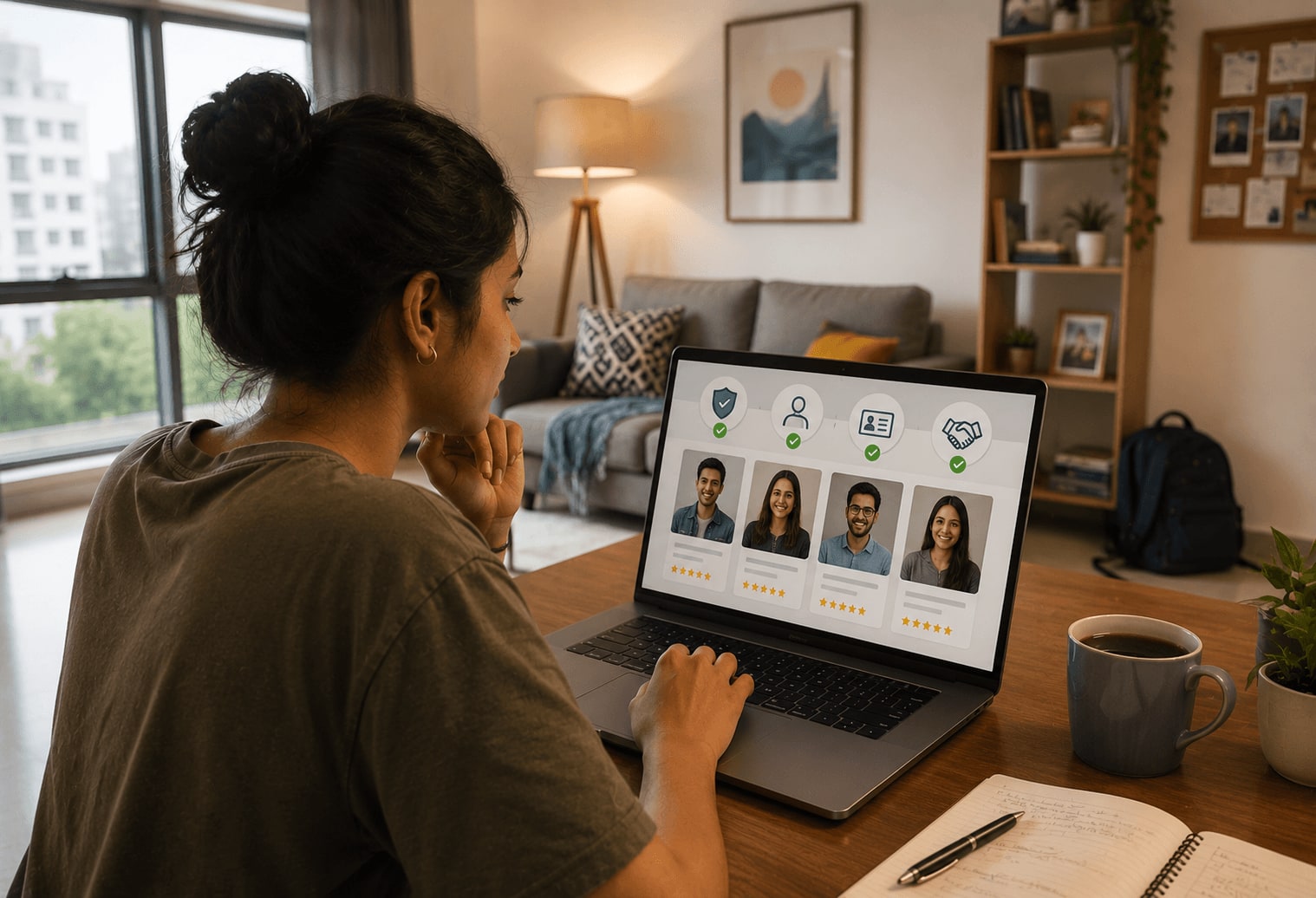
Almost every flatmate platform in India now puts a verified badge on profiles. Very few explain what was checked, and the word can cover anything from a one-time mobile number confirmation to a full background check.
The difference matters, because you are about to hand a stranger a share of your deposit and, on a joint agreement, a share of your legal liability. This is what each layer of verification proves, what it cannot tell you, and why matching is separate from verification.
What does verified actually mean?
Verification is not one check. It is a stack of separate checks, each proving something different, and most platforms disclose only that some check happened.
A profile marked verified might mean the person confirmed a mobile number. It might mean their government identity document was validated against an official database. Those two statements sit at opposite ends of a range, and both get the same badge.
The useful question is never whether a profile is verified. It is which layer was verified, and what that layer actually establishes.
The five layers of verification
Verification in the Indian rental context breaks into five distinct checks. They are usually performed independently, and a platform may run any combination of them.
Contact verification
The lightest layer. A one-time password confirms the person controls that mobile number at that moment.
This proves possession of a phone, nothing more. It does not establish who they are. It is worth having because it makes creating bulk fake accounts more expensive, but it should never be mistaken for identity.
Identity verification
Confirmation that the person is who they claim to be, using government-issued identity documents. In India, this usually means Aadhaar, PAN, passport, voter ID, or driving license, checked either as documents or through biometric authentication.
Done properly, this is the single most valuable layer. It converts an anonymous profile into a named, traceable individual, which changes the incentives of everyone involved. Someone whose real identity is tied to their behavior behaves differently from someone who operates behind a display name.
What it does not prove is anything about their conduct, their finances, or their trustworthiness.
Address verification
Confirmation of current and previous addresses, usually through utility bills, bank statements, or a prior rental agreement.
This layer is genuinely difficult in India, and it is worth understanding why. People relocate frequently for work, and utility bills in shared flats are commonly in the owner’s name or in one flatmate’s name rather than the occupant’s. A perfectly honest person may have no document in their own name for the address they have lived at for two years. Treat a failed address check as inconclusive rather than as a red flag.
Employment verification
Confirmation of employer, role, and sometimes income, usually through an offer letter, company identity card, salary slips, or direct confirmation from the employer.
For flat sharing, this is the layer most closely tied to your actual financial risk. If you will be named on the same rental agreement, you are exposed to their ability to keep paying rent, so their employment stability is relevant to you in a way it simply is not in a casual social context.
This layer also has a known weakness in India. Employment verification is more difficult when the employer is a small or medium enterprise that does not maintain formal HR records or respond to verification requests. An unverifiable employer is not evidence of dishonesty.
Background and criminal checks
The heaviest layer, and the least commonly applied to flatmates.
Two routes exist. Police verification, which in Karnataka is submitted through the state portal for a nominal fee and takes a few working days, is oriented around a landlord confirming a tenant. Professional screening agencies deliver broader checks, including criminal records and credit histories, and have access to databases that individuals cannot search directly.
Neither is routinely run flatmate-to-flatmate, and it is worth knowing when you read a verified badge.
Why police verification does not cover you
Tenant police verification runs from landlord to tenant. The owner submits the incoming tenant’s details, and many gated communities will not permit a move-in without the acknowledgment.
That process protects the landlord and satisfies the society. As someone joining an existing flat share, you are not a party to it; you receive nothing from it, and it says nothing about the people already living there. It is a compliance step, not diligence on your behalf.
Why verification matters more in flat sharing than in ordinary renting
In a conventional tenancy, verification is about a landlord assessing a tenant. In a shared flat, the exposure runs sideways, between people with no formal relationship to each other at all.
When several flatmates are named on a single rental agreement, liability is typically joint and several. Each named tenant is individually responsible for the entire rent and any damage, not just their share. If one person stops paying, the landlord can recover the shortfall from any of the others.
Where only one person is named, the exposure concentrates rather than disappears. The named tenant carries the entire legal relationship, and the unnamed occupants have no direct claim on the deposit they contributed.
Either way, you are taking on financial exposure to a person you met recently. That is why verification in flat sharing deserves more scrutiny than a badge, and it is the gap FlatX is built to address: verifying posters before profiles go live, so the match can begin with a real person and then be tested for fit.
What verification cannot tell you?
An honest account of the limits, because platforms rarely give one.
Future behavior. A clean identity and a stable job in March say nothing about a job loss in September.
How someone lives. No document reveals whether they cook at midnight, take calls from the living room, or leave dishes for three days.
Whether you will get along or not, verification proves that a person is real. It has no opinion on whether they are right for you.
Financial capacity over time. Employment verification is a snapshot. It confirms a job existed on the day it was checked.
Intent. Someone can pass every check and still be a difficult person to live with.
Verification narrows the range of who you might be dealing with. It does not eliminate risk, and any platform claiming otherwise is overselling. That is why the final step still matters: once the person is real, matching determines whether they fit.
Matching is a different problem from verification.
These two words get used together and describe entirely separate things.
Verification answers: Is this person real, and are their claims about themselves true? It is a factual question with a documentary answer.
Matching answers: Are these two people likely to live well together? It is a matter of preference, and no document can settle it.
A platform can do one well and the other badly. Verification without matching gives you a real stranger whose schedule collides with yours. Matching without verification gives you a compatible profile that may not correspond to a real person. Both layers have to work, and they work in that order: establish the person exists, then establish whether they fit.
The compatibility side depends on the factors that actually cause friction in a shared flat: sleep and work schedules, guests, food preferences and kitchen use, cleanliness standards, noise tolerance, and how bills get handled. FlatX approaches this with AI matching on those preference dimensions rather than relying on a listing description.
What to check on any platform
Whichever service you use, establish these before you commit:
Which layers are actually verified. Ask specifically whether the identity is document-verified or whether the badge shows a mobile confirmation.
Whether the person letting the room is verified, not only the listing. These are different things.
Whether verification is current: a check run eighteen months ago describes an eighteen-month-old situation.
What the platform does when verification fails. A service that removes unverified profiles is making a stronger claim than one that omits a badge.
Whether you can still do your own checks. No badge substitutes for reading the rental agreement, comparing the name on it to a photo identity document, and speaking to the landlord directly.
Verification on a platform reduces the work you have to do. It does not remove it. The same care that helps you spot fake listings and scams applies to real listings offered by real people.
Frequently asked questions
What does a verified profile mean on a flatmate app?
It varies by platform and is rarely defined. It can signify anything from a confirmed mobile number to a validated government identity document. Ask which specific layer was checked rather than relying on the badge.
Is identity verification the same as a background check?
No. Identity verification confirms that a person is who they say they are using documents such as Aadhaar, PAN, passport, or driving license. A background check examines criminal records, credit history, and previous conduct and is a separate, more extensive process.
Does police verification check my flatmates?
No. Tenant police verification is submitted by the landlord about incoming tenants. It is not a check performed on your behalf, and it does not tell you anything about people already living in the flat.
Why do some genuine people fail address verification in India?
Because utility bills in shared flats are frequently in the owner’s or one flatmate’s name, and because people relocate often for work. A missing document in someone’s own name is common and not, by itself, a warning sign.
Is employment verification reasonable to ask for?
Yes, particularly if you will both be named on the rental agreement. Under joint and several liability, you could be responsible for their rent if they stopped paying, which makes their employment directly relevant to your exposure.
Can a verified flatmate still be a bad flatmate?
Yes. Verification establishes identity and concrete claims. It has nothing to say about habits, schedules, cleanliness, or temperament, which is what compatibility matching addresses.
What is the single most useful check?
Document-based identity verification. It attaches a real, traceable person to the profile, which changes behavior and makes every later dispute easier to resolve.
Should I still meet in person if the profile is verified?
Always. Meet at the flat, read the rental agreement, and confirm the arrangement with the landlord before any money moves.
The short version
Verified is not one thing. It is five separate checks, and the badge on a profile rarely tells you which ones were run. Contact verification proves a phone. Identity verification proves a person. Employment verification speaks to the risk you are actually taking on. Address and background checks are more difficult and less commonly conducted.
None of it tells you whether you will get along, which is a matching problem rather than a verification one, and the two have to work in sequence.
If you are looking for a flatmate in Bangalore, start with a verified identity, then match on the preferences that actually cause friction, then read the agreement before you pay anything, in that order.