
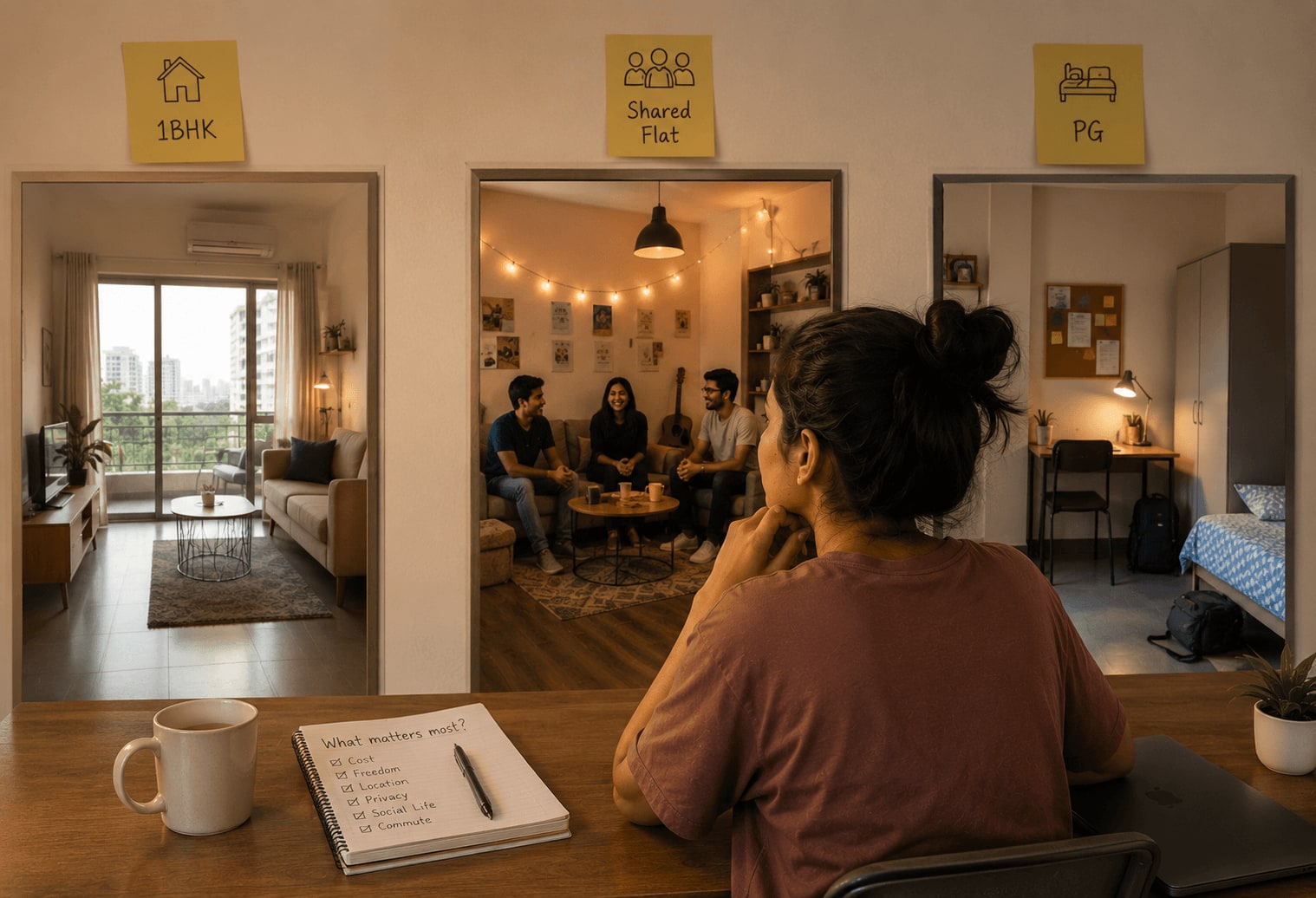
Three paths exist for someone moving to Bangalore to live alone. A 1BHK apartment on your own gives you privacy, control, and freedom. A shared flat gives you private space, a kitchen, and flatmates. A PG gives you a bed, structure, and simplicity. The choice is not about which is objectively best. It is about which trade-off best fits your situation, budget, and tolerance for independence or structure.
What each option costs per month
Sticker prices overlap so much that this comparison is rarely about rent alone. It is about setup cost, flexibility, and what else you get.
Solo 1BHK apartment
A solo 1BHK in Bangalore ranges from roughly Rs 8,000 to Rs 35,000 per month, depending on the area and furnishings. Budget areas like Electronic City or Yelahanka run from Rs 8,000 to Rs 15,000. Mid-range areas like BTM Layout, Marathahalli, or KR Puram run from Rs 15,000 to Rs 25,000. Premium areas like Koramangala, Indiranagar, or Whitefield run Rs 25,000 to Rs 35,000.
On top of monthly rent, add electricity (typically Rs 600 to Rs 1,500 per month, depending on AC use), water (usually included or Rs 100 to Rs 300), and internet (Rs 400 to Rs 800). Maintenance charges in gated societies run Rs 340 to Rs 1,000 per month.
Total monthly outlay for a solo 1BHK: Rs 9,000 to Rs 38,000 depending on area and what you add.
Shared flat room
A room in a shared 2BHK or 3BHK runs from roughly Rs 10,000 to Rs 20,000 per head, depending on area and split. A shared 2BHK in Marathahalli at Rs 35,000 per month divided by two is Rs 17,500 each. Divided by three, it is Rs 11,500 each.
Electricity is split and commonly runs Rs 200 to Rs 400 per person per month in a shared flat. Water is included or negligible. Internet is split and runs Rs 150- Rs 200 per person. No separate maintenance charges.
Total monthly outlay for a shared flat room: Rs 10,500 to Rs 21,000, depending on the area and the number of flatmates.
PG accommodation
A shared room in a PG runs Rs 6,000 to Rs 13,000 per month. A private room in a PG runs Rs 14,000 to Rs 25,000 per month. Many include meals, wifi, and housekeeping in the quoted figure.
Electricity, water, housekeeping, and common area maintenance are included. What is not included is the deposit, which typically runs one to two months of rent upfront.
Total monthly outlay for a PG: Rs 6,000 to Rs 25,000 depending on room type and what is included.
The deposit: the real decision maker
Monthly rent overlaps across all three options. The deposit is where they diverge sharply.
A 1BHK apartment requires a deposit that commonly runs three to ten months of rent, depending on the area and the landlord. On a Rs 15,000 1BHK, that is Rs 45,000 to Rs 150,000 upfront. On a Rs 25,000 1BHK, that is Rs 75,000 to Rs 250,000 upfront.
A shared flat deposit is six to ten months of rent on the entire flat, split among flatmates. A Rs 35,000 2BHK with a six-month deposit is Rs 210,000 total, or Rs 105,000 per person if splitting with one flatmate. That is a significant capital requirement.
A PG deposit is typically one to two months of rent. On a Rs 10,000 PG, that is Rs 10,000- Rs 20,000 upfront.
This single number explains most housing choices in Bangalore. If you have Rs 50,000 to move in, choose a PG. If you have Rs 100,000, join a shared flat. If you have Rs 200,000, get your own 1BHK.
Privacy and control
A solo 1BHK is yours. You decide when people visit, what you cook, what time you sleep, how clean the kitchen is, and what happens after 11 PM.
A shared flat room is semi-private. You have your bedroom, but the common spaces are negotiated territory. Who cooks what, when the kitchen gets cleaned, what noise is acceptable, and how often guests come over are all group decisions. FlatX surfaces the rules and exit terms before move-in, so you agree on these points upfront rather than discovering a disagreement mid-lease. But they remain negotiated.
A PG removes these negotiations. The operator sets the rules. You follow them, or you leave. Some people find this restrictive; others find it clarifying.
Flexibility and lock-in
A solo 1BHK typically requires an eleven-month agreement (due to registration thresholds) or longer. Breaking the lease early usually carries penalties.
A shared flat runs for eleven months with similar early-exit penalties. Leaving mid-lease is harder because you are leaving people in the lurch, not just a landlord, which makes the social pressure greater.
A PG typically runs three to six months with looser exit terms. Leaving a PG after two months is normal. Leaving a shared flat after two months is unusual.
If you are uncertain how long you will stay in Bangalore, or if you change jobs frequently, choose a PG or a shared flat for flexibility. Choose a 1BHK on your own if you want more lock-in and stability.
Utilities and convenience
A 1BHK gives you a kitchen, so you control food. It also means you are responsible for cooking, cleaning the kitchen, taking out the trash, and daily household logistics.
A shared flat gives you a shared kitchen, so you can cook if you want. Someone else is there to share the work and the conversation. It also means compromise on schedules, cleaning standards, and what belongs in the fridge.
A PG typically includes meals and housekeeping. If your PG includes those things, your monthly burden is simply paying rent and using the space. Everything else is someone else's problem. This is the convenience trade-off: less control, less responsibility.
The commute and location flexibility
A solo 1BHK is wherever you choose to rent. You can live in your preferred neighborhood and commute from there.
A shared flat shares a location with your flatmates. If you join an existing household, you are moving to their area unless you negotiate.
A PG is typically located by the operator, often amid tech parks or near major transit. Your location options are 'this PG' or 'another PG,' not 'I want to live in HSR.'
When each makes sense
Choose a solo 1BHK if:
Choose a 1BHK on your own if you plan to stay in Bangalore for more than 2 years. The per-month cost after amortizing the deposit becomes reasonable.
You value privacy and control over cost. You want to set your own rules and not negotiate with flatmates.
You possess a stable commute and know which area you want to live in.
You have the capital upfront. A 1BHK requires Rs 75,000 to Rs 200,000+ to move in.
Choose a shared flat if:
You are staying one to three years. Shared flats offer a middle ground between commitment and cost.
You want private space but don't need complete autonomy. Flatmates provide social structure and mutual responsibility.
You can negotiate and compromise on daily logistics. Shared flats require ongoing conversation.
You have an upfront deposit of Rs 90,000 to Rs 150,000.
You prefer kitchen access and control regarding meals to a PG structure and included food.
Choose a PG if:
You just arrived in Bangalore and don't know where you want to live. PGs let you explore the city before committing.
You are staying under a year. Short-term PG stays are normal. Short-term 1BHK exits are expensive.
You have limited upfront capital. A PG deposit is Rs 10,000-20,000, compared with Rs 100,000+ for alternatives.
You want simplicity and someone else to handle housekeeping and meals.
You are on a project-based assignment and may relocate.
You do not want to deal with finding flatmates or negotiating house rules.
The economics: total cost of stay
Monthly costs are only part of the picture. A six-month stay and a two-year stay have very different economics.
Six months in a PG: Rent Rs 6,000 to Rs 12,000 per month, deposit Rs 10,000 to Rs 20,000. Total: Rs 46,000 to Rs 92,000.
Six months in a shared flat: Rent Rs 12,000 to Rs 18,000 per head per month, deposit Rs 90,000 to Rs 120,000. Total: Rs 162,000-Rs 228,000. You recover your deposit at the end, so the net cost is the rent: Rs 72,000 to Rs 108,000 plus setup friction.
Six months in a solo 1BHK: Rent Rs 15,000 to Rs 25,000 per month, deposit Rs 75,000 to Rs 150,000. Total: Rs 165,000 to Rs 300,000. You recover the deposit, so the net is Rs 90,000 to Rs 150,000.
For a six-month stay, choose a PG. It is clearly the cheapest in both upfront cost and total cost.
Two years in a PG: Rent Rs 6,000 to Rs 12,000 per month times 24 months, plus deposit. Total: Rs 154,000- Rs 308,000. But after two years, you have paid it all, with nothing recovered.
Two years in a shared flat: Rent Rs 12,000 to Rs 18,000 times 24 months, plus deposit Rs 90,000 to Rs 120,000. Total: Rs 378,000- Rs 552,000. You recover Rs 90,000 to Rs 120,000, so the net cost is Rs 288,000 to Rs 432,000. Per month: Rs 12,000 to Rs 18,000.
Two years in a solo 1BHK: Rent Rs 15,000 to Rs 25,000 times 24 months, plus a deposit of Rs 75,000 to Rs 150,000. Total: Rs 435,000- Rs 750,000. You recover Rs 75,000 to Rs 150,000, so the net cost is Rs 360,000 to Rs 600,000. Per month: Rs 15,000 to Rs 25,000.
Over two years, a shared flat and a solo 1BHK become more competitive than a PG in per-month cost, because the deposit amortizes. Choice shifts from 'which costs least' to 'what lifestyle do I want.'
Common mistakes
The biggest mistake is locking into a 1BHK or shared flat for security without being sure of your timeline. If you get a job offer elsewhere in month three, a 1BHK with an eleven-month lease and a six-month deposit penalty is an expensive education.
The second mistake is joining a shared flat without agreeing on exit terms. People leaving mid-lease without notice, refusing to find replacements, or arguing over deposit splits are the most common causes of a shared flat breakdown.
The third mistake is assuming a PG is temporary. Some people end up in a PG for two years out of inertia, paying twice as much total as they would have in a shared flat.
How to decide
Ask yourself these questions in order:
How long am I staying? Under a year, PG is probably right. For one to three years, a shared flat makes sense. Over three years, 1BHK economics work.
Do I have the capital? PG requires Rs 20,000. A shared flat requires Rs 100,000+. 1BHK requires Rs 150,000+. This is often the decision-maker.
How much social structure do I want? PG gives you structure. 1BHK gives you autonomy. A shared flat is the middle ground.
Do I have a stable commute? If yes and you know your area, a 1BHK or shared flat works. If no, a PG lets you explore.
Can I handle negotiation? Shared flats require ongoing negotiation. 1BHKs don't. PGs require none.
Answer these questions honestly, and the choice usually becomes clear.
Frequently asked questions
Is it worth getting my own 1BHK in Bangalore?
Only if you are staying more than one year and have the upfront capital; over two years, the economics are reasonable. Over three years, a 1BHK is a good investment.
Can I save money by living in a shared flat rather than a PG?
In terms of monthly rent, shared flats and PGs are similar. The total cost of stay depends on how long you stay. Over two years, a shared flat is cheaper per month because the deposit amortizes. For a six-month stay, a PG is cheaper because you don't have to pay a large deposit.
What is the typical shared flat deposit?
Six to ten months of the flat's rent, split among flatmates. On a Rs 35,000 2BHK split two ways, that is Rs 105,000 to Rs 175,000 per person.
Can I negotiate the 1BHK deposit down?
Sometimes. In slower markets or with independent landlords, a deposit of four to five months is possible if you agree to a longer lease or a lock-in clause. In premium areas or with societies, six to ten months is the going rate.
What happens to my PG deposit if I leave early?
That depends on the PG operator and the agreement you signed. Some refund it in full. Some charge a notice penalty. Read the agreement before you sign.
Is it weird to live alone in a PG?
No. Many people live alone in PGs. The single-room option is available for this reason, though it costs more.
Can I break a shared flat lease if things go wrong?
Legally, depends on the agreement. Practically, you would need to find a replacement or negotiate with your flatmates and the landlord. It is harder and slower than breaking a PG lease.
The short version
The choice between a solo 1BHK, a shared flat room, and a PG is mostly about how long you are staying and how much capital you possess upfront. A PG is the cheapest to enter and exit. A shared flat is the social middle ground and offers reasonable economics over two years. A solo 1BHK is most expensive to enter but gives the most autonomy and works well over three-plus years.
For the first few months, a PG is the safest choice. After that, if you are staying, a shared flat offers better value than keeping a PG. If you are really staying for years, a 1BHK makes sense.
The biggest risk is rushing into a 1BHK before you know Bangalore, only to discover you want to live in a different area or an entirely different city.
If you decide a shared flat is right, FlatX filters flatmates by area and workplace and documents house rules before move-in, which prevents the most common friction points in shared arrangements.